Tree Service in Lincoln, CA
Removals, trimming and storm cleanup for Lincoln yards, planned around the local soil and the oaks.
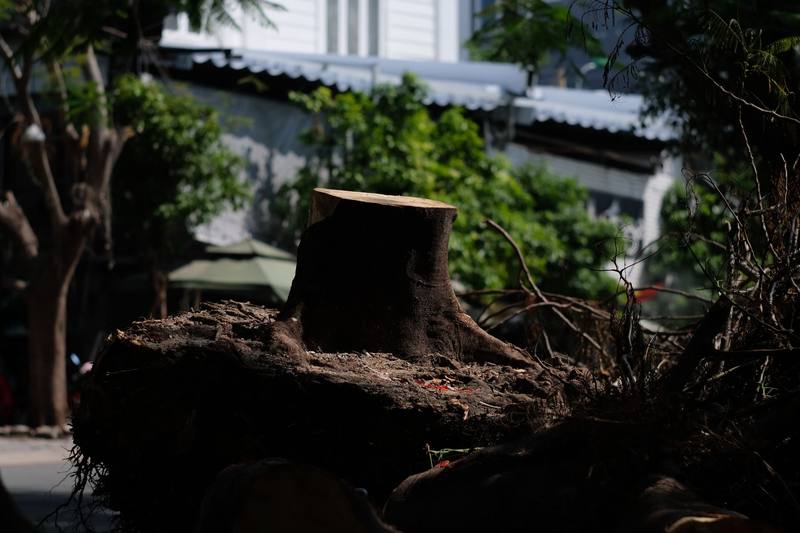
Tree service in Lincoln comes down to four jobs: tree removal, trimming and pruning, storm cleanup and stump grinding once the tree is down. Lincoln jobs are run from our base in Roseville, about 10.3 miles away. Soils with a hard or clay layer not far down keep roots shallow here, and long, hot summers are followed by a wet winter; both shape the work.
Tree removal in Lincoln
Most tree removal in Lincoln happens in one of two places: a subdivision yard where a tree has outgrown the strip between two houses, or an older parcel where a big valley oak or pine has died or started to lean. Much of Lincoln was built after the mid-1990s, so many yard trees went in with the houses and have now filled the space they were given.
Sectional takedown between houses
A side yard in a newer subdivision rarely has room to drop a tree in one piece, so it comes out by sectional takedown, a few feet at a time from the top. Each section is cut small enough to land in a cleared spot or is lowered on a rope from a climber or a lift.
Rigging over roofs and fences
Between two houses a heavy limb cannot simply fall onto a roof or a fence: it is tied off, cut, and let down on a line that runs through a block higher up, with a ground worker easing it through a friction device at the base. Before hiring a tree service, ask how the crew plans to rig a tree beside the house and where each piece will land.
Dead pines and storm damage
Dead wood is the hard part of a removal: a dry limb can break under a climber's weight or under a loaded rope. A common stress behind a dying tree here is summer heat: July highs average 94 °F. A pine weakened by heat and dry ground draws bark beetles, which often finish it off. Storm-broken wood is a separate risk: a trunk that split or a limb hung up in the crown is still under tension and can move as the weight comes off, so it comes down in smaller pieces.
The chipper and the wood
The limbs are fed through a chipper at the curb as they come down, and the brush from a whole yard ends up as a load of chips. Check whether the quote includes hauling the chips and trunk wood away. A pile of chips left behind makes good mulch under shrubs, kept a hand's width back from the stems.
Trimming and pruning Lincoln trees
From late fall through winter, deciduous trees in Lincoln are bare and the summer heat is months off, which makes it the best stretch for most tree pruning. Routine tree care lifts limbs off a roof and takes weak wood out of a crown before a winter storm does it for you. Ask any tree service to explain each cut before it is made.
Crown thinning on mature oaks
Crown thinning lightens a canopy from the inside so it catches less wind. A mature valley oak should get only a short list of cuts, mostly deadwood and limbs that cross and rub. Large cuts on an old oak leave wounds it seals slowly and expose long-shaded bark to the July sun. Stripping a limb bare except for a tuft at the end, which arborists call lion-tailing, makes any tree more likely to break.
Deadwood and limbs over the roof
In a winter storm the dead branch wood in a crown usually comes down first, so it is the first thing a trim should take out. Limbs that rest on shingles scrape them in every wind, and leaves from overhanging branches fill gutters through the wet season, which here runs from October through April. Any limb touching a power line is for the utility to deal with before a tree crew goes near it.
When to prune citrus trees in California
In California, citrus trees are pruned after the last frost and before the new flush of growth, so late winter or early spring. The cuts are few: dead twigs, and suckers coming from below the graft. Leave the leafy canopy that shades the trunk and the main limbs, because in a Lincoln summer bark that a heavy cut has suddenly exposed can sunburn and split.
Lincoln soil, roots and wind-thrown trees
Lincoln's USDA soil series go a long way to explaining why many trees here root shallow, and why a storm tends to tip one over at the roots rather than snap its trunk. The survey maps three units around the town: Xerofluvents, San Joaquin and Cometa.
Xerofluvents on low ground near the creeks
Xerofluvents are young soils laid down by moving water, the kind found on low ground near creeks such as Auburn Ravine. They are moderately well drained and in hydrologic group A, so rain soaks in fast. Trees rooted in them can go deeper than on the San Joaquin and Cometa ground nearby. A tree on a creek bank is the exception: it loses support on one side when the bank erodes.
San Joaquin and Cometa: a hard layer below
USDA rates San Joaquin and Cometa well drained, but puts both in hydrologic group D, where water moves through the ground slowly. Each has a restrictive layer under the topsoil. San Joaquin has a dense clay subsoil over a cemented hardpan, and Cometa changes abruptly from sandy loam to clay. Roots meet that layer and spread sideways instead of going down.
Why trees tip over in winter storms
On these soils a tree usually blows over in the wet season, after rain has collected above the clay or hardpan and softened the root zone. One strong gust can then pull the shallow root plate up in a single piece. If a tree leans after a storm, or the soil on one side has cracked or lifted, have it checked before the next one.
How far an oak tree should be from a house
A large oak should stand at least 20 to 30 feet from a house, and a valley oak, which grows wider than most, needs the far end of that range. Its roots reach well past the edge of the canopy, and where San Joaquin or Cometa ground puts clay or hardpan below them they stay near the surface, right where footings and patios go. Standing close to a house does not on its own mean an oak has to go; what hurts it is roots cut for a patio or a trench, or a lawn watered around it all summer, which invites root rot.
When to call an arborist in Lincoln
When the question is whether a tree should stay at all, start with an arborist. An arborist visit goes over the whole tree, root flare, trunk, main unions and crown, and it comes first for a large oak or for any tree near the house that has started to thin or lean.
If the City of Lincoln or Placer County asks for an arborist report before it issues a permit, the person who signs it should be an ISA-certified arborist, so ask for the certification number of whoever writes the report.
Before paying anyone for tree services, ask four questions and get the answers in writing:
- How each tree will come down, and what will be under it when it does.
- Who insures the crew, with the certificate coming to you straight from the insurer.
- What the stump and the haul-away each cost, shown as their own items on the quote.
- Who checked whether the tree needs a permit, and what the city or county said.
Stump grinding after the tree comes down
With the tree gone, a stump grinder cuts what remains to 6 to 12 inches below grade, ready for turf or a bed. The wheel leaves a heap of wood chips and soil that either goes back in the hole or is hauled away and replaced with topsoil.
On San Joaquin and Cometa ground, with clay or hardpan below, a hole packed with chips can stay wet after winter storms and sinks as the wood rots, so hauling the grindings and filling with soil leaves firmer ground. Surface roots from a big oak can be ground out along their length as well, which matters where they have lifted a walkway or a driveway edge.
On a soft lawn one trip is better than two, so ask whether the tree service quote includes grinding the stump while the crew is there. Stumps are the bulk of our work; the stump grinding in Lincoln page covers oak stumps and backfill.
Nearby towns for tree service
We offer the same tree care services in Rocklin, Loomis and Penryn, all close to Lincoln. Oak and permit rules differ from town to town. Each is set by the town's city hall or by Placer County, depending on where the lot sits, so ask before the first cut.
Local details for Lincoln
- ZIP codes: 95648
- Distance: About 10.3 miles away in a straight line
- Main soils (USDA soil survey): Xerofluvents (moderately well drained, hydrologic group A); San Joaquin (well drained, hydrologic group D); Cometa (well drained, hydrologic group D)
- Nearby: Loomis, Penryn, Rocklin
About Lincoln: Lincoln, CA on Wikipedia · Lincoln on Google Maps
FAQ
Tree Service questions from Lincoln
Tree work in Lincoln has no single price: the cost follows the size of the tree and how hard it is to get the wood to the ground without hitting anything. A pine in an open back yard is a short job, while a valley oak over a roof means rigging most of the pieces and carrying them out through a side gate. We quote each job after seeing it, and so should any tree company; ask each one to price the stump and the haul-away on their own lines.
Late fall through winter is usually the least costly time to remove a tree in Lincoln, mostly because the work is easier: a deciduous tree with its leaves off weighs less, and the crew can see every limb it has to rig. The catch is the wet season, which runs from October through April, when heavy equipment can rut a soaked lawn. Birds nesting in the tree in spring can also delay a removal. A removal planned for a dry spell is simpler than one done in a rush after a storm.
It depends on the address: the City of Lincoln sets the rule for oaks inside city limits and Placer County sets it outside them, so ask that office before cutting any oak. Ask whether pruning big limbs or digging near the roots is covered as well as removal. Get the answer in writing and keep it with the job paperwork.
Services
Services in Lincoln, CA



Get a quote
Request a tree service visit in Lincoln
Send a photo of the stump with a tape measure across it and say what you want in the spot afterwards. We reply with a quote and any questions about the gate or the ground. Call or text (279) 529-0050 or email info@stumpgrindingroseville.com.